
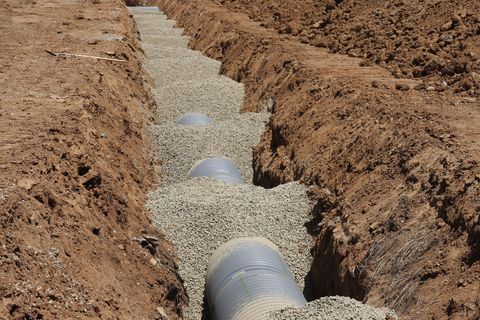
What counts as drainlaying
Under the Plumbers, Gasfitters, and Drainlayers Act 2006, drainlaying means laying a drain; altering, extending, repairing, opening up or renewing one; connecting a drain to a sewage tank or disconnecting it; and fixing or unfixing a gully trap or other trap on a drain.
The Act's drain is a pipe carrying foul water, stormwater or industrial liquid waste. Pipes that a council or the Crown owns or maintains are outside it, as are roof downpipes and perforated drains that only collect groundwater.
In PGDB's plainer words, drains are the underground pipes taking wastewater or stormwater to a septic tank or a council sewer. Fixtures and the traps, waste pipes and water pipes serving them fall under sanitary plumbing instead. Our guide on plumber, gasfitter or drainlayer sorts out which trade you need.
Jobs that need a drainlayer
- Drains for a new build or extension.
- A broken, cracked or root-filled drain: see sewer and drain repairs.
- Moving or replacing a gully trap.
- Rainwater from downpipes, paving and driveways: see stormwater drains.
- Drains to or from a septic tank.
- No-dig repair by pipe relining, and camera inspections to find faults.
Licence classes and supervision
PGDB registers drainlayers in three classes. A certifying drainlayer can do all drainlaying, supervise others and certify work. A drainlayer can do all the work too, but under a named certifying supervisor who needn't be on site, and can't certify. A restricted drainlayer has the trade qualification but hasn't yet passed the Board's exam, and also works under supervision.
The middle class was called 'Tradesman' until 1 April 2025, when it became plain 'Drainlayer'. The new names didn't change what anyone is allowed to do.
Licences belong to people, not businesses. A company is within the law when the individuals doing the work are authorised, so the person to check is whoever turns up, along with their supervisor.
How to check a drainlayer
Ask for the licence
PGDB says to ask to see the New Zealand Practising Licence, as a card or in the PGDB app, and check the expiry date. Licences run out on 31 March each year.
Check the trade
Plumbing, gasfitting and drainlaying are separate, so make sure the licence covers drainlaying.
Search the register by name
Ask for Licensed says to search the person's first and last name, since the register doesn't recognise business names, and look for a tick or green in the far-right column. People whose licence has lapsed are listed too, so appearing there isn't enough.
Look up the supervisor
If they aren't certifying, ask who supervises them and check that person on the register as well. Our PGDB licence guide has the details.
What a drainlayer will do
For a repair, a drainlayer will find the fault, often with a camera, then mark the pipe's route and depth before digging or relining. For new work, they'll plan the route and fall of the drains and the connection to the sewer, stormwater system or tank.
On consented work they'll book the council's inspections or, if they hold a self-certification endorsement, certify eligible work themselves. Either way, expect the drain tested, the ground reinstated and the paperwork handed over.
Blockages are usually cleared by a plumber or a drainlayer; our blocked drains page covers that side.
What changes the job
- Depth and length of the drain run.
- What sits on top: lawn, garden, concrete, a driveway or the house.
- Ground conditions, such as rock, clay, water or tree roots.
- Whether a building consent and council inspections are needed.
- A connection to the public network, which brings the council or provider into it.
- Room for a digger to get in.
Consent, sign-off and self-certification
Drainlaying is building work, so it needs a building consent unless an exemption applies. Schedule 1 of the Building Act exempts some drain work when an authorised person does it: repairs using comparable products, replacing a section with a comparable one in the same position, opening and reinstating a purpose-made access point, and minor alterations such as shifting a gully trap. Making a new connection to a council or utility service isn't covered, and exempt work still has to meet the Building Code.
The self-certification law took effect on 30 June 2026, and from 7 September 2026 certifying drainlayers could apply to PGDB for the endorsement. An endorsed drainlayer can sign off eligible consented work with a certificate of compliance in place of council inspections. The building consent is still needed.
If an endorsed drainlayer wasn't named on the consent application, the owner must tell the council in writing who they are. The drainlayer has 10 working days after finishing to lodge the certificate with PGDB and give it to you with supporting documents. Keep it, because the council can refuse the code compliance certificate for that work without it. Our guide to certificates of compliance untangles the different certificates that share the name.
Where your drain meets the public one
Each council or water provider draws that line its own way. Three examples we've confirmed:
Christchurch: the council says to call a drainlayer, ideally one with a CCTV camera, who will work out whether a blockage is on the private or council section of the lateral.
Waimakariri: the council owns and maintains all sewer mains, and landowners are responsible for the private sewer lateral. For a blocked lateral, it says to call a local drainlayer or plumber.
Whakatāne: if you're unsure where a fault is, the council says to contact a drainlayer or plumber, who should report it to the council if it's within its network.
Elsewhere, see who fixes a blocked drain and your city page, such as Christchurch or Whakatāne, or find yours under locations.
Unlicensed drainlaying
Doing or helping with unauthorised drainlaying can bring a fine of up to $10,000, and a homeowner who knowingly permits or pays someone unauthorised to do it commits an offence too. PGDB also warns that your insurance may be void if unlicensed work goes wrong, and that some people advertise drainlaying without being licensed or authorised.
Questions to ask a drainlayer
- Who will do the work, and who is their certifying supervisor?
- Does this job need a building consent, and who applies for it?
- Will you self-certify, or will the council inspect?
- What documents will I receive when the work is completed?
- Is this a written quote or an estimate?

What we would do
Get the problem seen before you get it priced. Ask for camera footage of any fault, find out whether consent is needed and who handles it, and look up the drainlayer and their supervisor on the PGDB register by name. For bigger jobs, collect written quotes from more than one, as PGDB suggests, and file every certificate you're given with your property papers.