
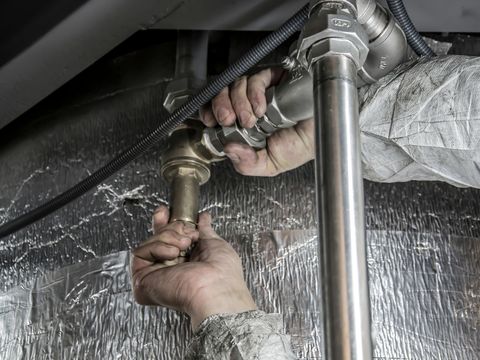
How backflow happens
Water is meant to travel one way: from the network, through your pipes and out of your taps. If pressure in the supply drops, or pressure on your side rises, water can be drawn or pushed back the other way.
Whatever is connected to your plumbing can then end up in the supply. Think of a hose left lying in a pool or a bucket of cleaning chemicals, an irrigation system that doses fertiliser, a rainwater tank or bore that's cross-connected to the mains, or equipment in a workshop or commercial kitchen.
When backflow is worth asking about
- You have irrigation, especially with fertiliser or chemical dosing.
- The property has a rainwater tank or bore as well as a mains connection.
- A pool, spa or water feature is filled from the mains.
- You run a business with equipment connected to the water supply.
- Your water provider or council has written to you about a device or a test.
What the Building Code says
Clause G12 of the Building Code requires buildings with water outlets, sanitary fixtures or sanitary appliances to have safe and adequate water supplies. It also requires water systems to be installed so that the system, and any backflow prevention devices, can be isolated for testing and maintenance.
The Acceptable Solution G12/AS1, now at Amendment 14, is one way to comply with that clause, and it sets out requirements to avoid contamination among other things.
Your water provider's requirements
Requirements for a device on a particular property may come from your water provider or council, and we haven't checked each one's rules. Ask yours directly whether your property needs a device, which type, and how often it has to be tested. Our locations pages name the water provider for each place.
What a plumber will do
A plumber will look at what's connected to your water supply and how much of a hazard each connection is. Devices range from simple non-return valves to testable assemblies with test points, and the right one depends on the risk.
They'll fit it with valves either side so it can be isolated, as the Code asks, and test it once it's in. Ask how often it should be tested after that, and who is qualified to test that type of device.
Who can do the work
Fitting a device into a pipe that supplies water is sanitary plumbing, so only an authorised person may do it. Check the person's current PGDB licence, and if they aren't a certifying plumber, ask who their supervisor is.
Replacing a device with a comparable one in the same position needs no building consent when an authorised plumber does it. New work on a property with other plumbing changes may be part of a wider consent, so ask.
What you can do
You can
- Keep hose ends out of pools, buckets, drains and tanks.
- Tell the plumber about every water source and connection: tank, bore, irrigation, pool.
- Keep test reports with your property papers.
Leave to an authorised tradie
- Installing, moving or replacing a backflow device.
- Testing and servicing testable devices.
- Separating a tank or bore supply from the mains.
- Changes to irrigation that's connected to the mains.
Questions to ask
- Does my water provider require a device on this property?
- Which type of device suits the hazard here, and why?
- Can it be isolated for testing, as the Building Code requires?
- How often does it need testing, and who can test it?
- Will I get a written record of each test?

What we would do
Start by listing everything on the property that touches the water supply, from the irrigation to the pool top-up. Ring your water provider and ask whether it requires a device for a property like yours. With those two answers, a plumber can price the right device instead of guessing. Tell us what's connected and what your provider said, and we'll match you with an authorised plumber who fits and tests backflow devices.