
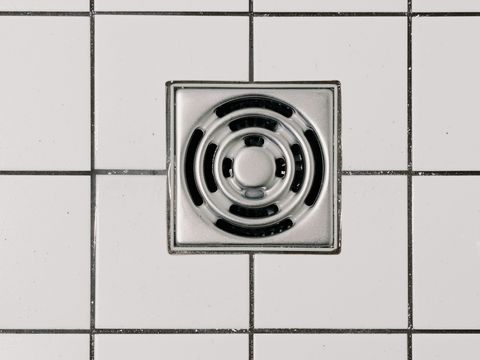
If sewage is coming up
Sewage rising through a shower, a floor waste or the gully trap outside means the drain is blocked further down. Stop running water in the house: hold off on flushing, showers, the dishwasher and the washing machine. Keep children and pets clear, wash your hands after any contact, and ring a plumber or drainlayer. If it's spilling from a manhole or onto the street, that belongs to the public network: report it to your council or water provider straight away.
Why a drain smells at all
Every basin, shower, bath, sink and floor waste has a trap under it: a U-shaped bend that stays full of water. That small pool is all that stops sewer air drifting up the pipe into the room. If it dries out, or gets dragged out as a rush of water passes, the smell comes straight through.
Your waste pipes need air too. Vent pipes, usually poking up through the roof, let air into the system so water drains smoothly without sucking traps dry. A blocked or missing vent often shows up as gurgling from one fixture while another drains.
Outside, the waste pipes from the kitchen, bathroom and laundry usually empty into the gully trap: the grated drain at ground level where the house waste meets the underground drain. It has a water seal of its own, and it's a common source of smells by the back door.
Where it smells, and the usual suspect
| Likely cause | Try this first | |
|---|---|---|
| Spare shower, floor waste or guest basin | The trap has dried out from lack of use | Run water into it for a minute |
| Bathroom basin | Hair and soap scum in the trap, or slime in the overflow hole | Clean the plug, the overflow and the waste grate |
| Kitchen sink | Fat and food scraps coating the pipe | Scrape plates into the bin, then run hot tap water |
| Base of the toilet | A failed seal where the pan meets the waste pipe | Look for damp or staining at the base, then ring a plumber |
| Outside by the back door or laundry | A dry, dirty or partly blocked gully trap | Clear the grate and pour a bucket of water in |
| All through the house, or with gurgling | A blocked vent, or a cracked or blocked drain underground | Ring a drainlayer |
Easy fixes worth a go
Top up the traps
Pour water into every floor waste, unused shower and spare basin. In a bathroom nobody uses, make it a habit every week or two.
Clean the bits you can reach
Lift out plugs, pop-up wastes and shower grates, and pull out the hair and slime with gloves on. The overflow hole in a basin collects grime as well, and a bottle brush reaches it.
Use hot tap water, not the kettle
Hot water from the tap helps shift soap and grease. Water straight off the boil is hard on plastic waste pipes and their joints, so let it cool first.
Look after the gully trap
Keep the grate clear of leaves and soil, and don't let garden beds, mulch or paving creep over it. After a dry spell, refill its water seal with a bucket.
Use one product at a time
Never pour bleach after a drain cleaner or mix two drain products together, because some combinations give off toxic fumes. Follow the label and open a window.
When the fault is underground
If the smell is worst outside, or several fixtures smell and gurgle together, the problem is often in the drain under your section: a crack, a joint pulled apart, tree roots or a partial blockage. A drainlayer will usually run a camera through the pipe (CCTV drain inspection) to find it before quoting any repair.
Who pays depends on where the fault sits and which council or water provider you're with, and each one draws its line in a different spot. In Christchurch, for example, the city council says about 70 per cent of lateral blockages turn up in the private section, between the household gully trap and the boundary. Our guide to who fixes a blocked drain sets out the rule for each provider we've confirmed.
New Plymouth District Council wants to hear straight away about a strong smell of sewage, along with sewage leaks and lifted or damaged manhole lids, on 06 759 6060. Wherever you live, leave manhole lids alone: Napier and Whanganui councils both say members of the public, plumbers and drainlayers must not lift one.
Smells from a septic tank
On a section with a septic tank, a smell near the tank or its disposal area is a job for a drainlayer. Connecting or disconnecting a drain to a sewage tank is drainlaying under the law, so only an authorised drainlayer can do it. Our page on septic tanks covers what they check.
What's yours to do, and what isn't
You can
- Top up dry traps and the gully trap with water.
- Clean plugs, grates and overflow holes.
- Clear a blocked drain, as long as you don't alter or repair the inspection pipe or vent pipe (PGDB's homeowner list).
- Keep wipes, fat and food scraps out of the drains.
Leave to an authorised tradie
- Taking off or refitting a trap, or any waste, soil, vent or overflow pipe.
- Replacing a toilet pan seal or connector.
- Any repair to the drain itself, including the gully trap.
- Camera inspections and clearing tree roots.
- Anything to do with a septic tank connection.

What we would do
Top up the traps and clean the grates before anything else, because a bucket of water cures more sewer smells than any spray. If the smell is back within days, or it's worst outside by the gully trap, stop masking it and get the drain looked at with a camera. Seeing the fault first means nobody digs up the lawn on a guess, and a drainlayer who specialises in drains can tell you whether the broken section is on your side of the line.