
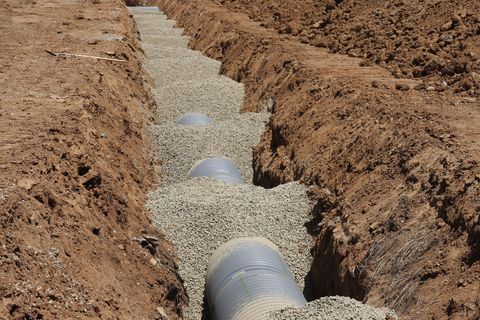
What's local about drainlaying in Tauranga
Your drains, your repair
The council says any damage or blockage in wastewater pipes inside your property boundary is the owner's to fix, and that keeping gully traps working is the homeowner's job. It's best to ask the council directly about anything beyond the boundary.
Approved contractors for any connection
Every connection to council-owned infrastructure needs an approved service connection application, and every one except a vehicle crossing must be done by a council approved contractor. A PGDB licence and council approval are two separate things.
Overland flow paths cross private land
Over 55,000 properties drain into the council's stormwater network, and it has mapped 61 km of overland flow paths where water runs in extreme rain, on private as well as public land. Its flood rules for development followed widespread flooding in 2005.
What blocks Tauranga's sewers
The council puts most wastewater blockages down to wet wipes, fats and cooking oil going down toilets and sinks. A drain that keeps blocking may simply need clearing; one with roots or cracks needs repair.
Connecting to the council's pipes
Apply for a service connection
A service connection application (SCA) has to be made and approved before any connection to council infrastructure. Water supply connections are normally arranged through the subdivision or building consent.
Nominate an approved contractor
The council won't issue approval until an approved contractor has been named and its SCA team told. Your drainlayer may hold that approval or work alongside a company that does.
Get the work done and signed off
The drain itself is drainlaying, so the person laying it needs a current PGDB licence for drainlaying. Questions about an application go to the council on (07) 577 7000.
Repairs, consent and self-certification
Drainlaying covers laying a drain, altering, repairing, opening up or renewing one, and fixing or unfixing a gully trap. Schedule 1 of the Building Act lets an authorised person repair a drain with comparable materials, or replace a length with a comparable one in the same spot, without a building consent. Moving a gully trap is a minor alteration that's also exempt. A new connection to a council service is not, and the work has to meet the Building Code regardless.
Where consent is needed, a certifying drainlayer with a self-certification endorsement can certify eligible work instead of council inspections. They lodge a certificate of compliance with PGDB and give it to you, with supporting documents, within 10 working days of finishing. Keep it: the council can refuse a code compliance certificate for that work without it.
Your part, and the drainlayer's
You can
- Keep gully traps, roof gutters and drains clear of leaves and debris.
- Check drainpipes and soakage holes regularly, as the council asks.
- Clear a simple blockage, without altering or repairing the inspection pipe or vent pipe.
- Keep wipes, fat and cooking oil out of the drains.
Leave to an authorised tradie
- Repairing, relaying or relining a broken drain.
- Moving or replacing a gully trap.
- Any connection to council stormwater or wastewater pipes, through an approved contractor.
- New drains for an extension or second dwelling.
Questions for a Tauranga drainlayer
- Are you, or the company you work with, a council approved contractor?
- Does this job need a service connection application?
- Can you film the drain so we can see the fault?
- Will you self-certify, or will the council inspect?

What we would do
For a repair inside your boundary, ask for camera footage first, then a written quote for the fix it shows. For anything that touches council pipes, ask at the start who the approved contractor is and who lodges the service connection application, because the council won't approve the work without both. If water runs across your section in heavy rain, mention it: overland flow paths cross private land here.