
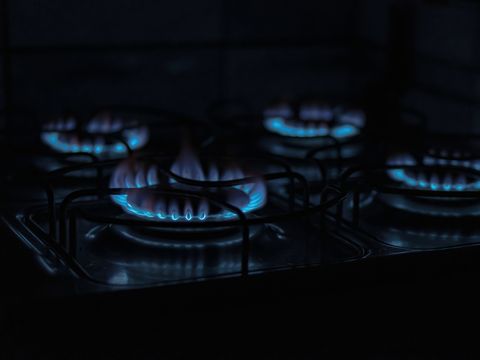
Gas smell in a Hamilton home
Leave the area
Don't use switches, electrical equipment, matches or your mobile near the smell. Natural gas has no smell of its own; the rotten-egg odour is added so a leak can be noticed.
Shut the meter valve if it's safe
Firstgas puts the isolation valve at the gas meter, usually on the front of the house or down the side near the front, occasionally at the boundary. Turn the handle clockwise until it's level with the ground. Older valves without a handle need a spanner.
Ring from somewhere safe
Firstgas's line is 0800 802 332, staffed around the clock, and it aims to reach emergency call-outs within an hour. Fire, an explosion or any risk to life goes to 111.
A gasfitter for your side
Leaks in your pipes or appliances are fixed by an authorised gasfitter, and the gas stays off until then. Our gas leaks page explains what follows.
Gas in Hamilton: the local picture
On the Firstgas network
Firstgas runs the medium and low pressure gas pipes across parts of Waikato, as well as Northland, Bay of Plenty, Gisborne and Kāpiti. If your street has a main, you can apply to connect; you'll need a retailer and a gasfitter as well.
Gas heaters well above the national rate
At the 2023 Census, 16.2% of Hamilton dwellings used a fixed gas heater as a main type of heating, against 9.5% nationally. Wood burners were rare, at 8.2%.
Close to half don't own
46.4% of Hamilton households didn't own their home or hold it in a family trust at the 2023 Census, against 34% nationally. If you rent, report a gas smell or a faulty heater to your landlord quickly; the repair is still a gasfitter's job.
Older network pipe under review
Firstgas says polyethylene gas pipe laid between the 1960s and early 1980s can develop weak points, and it's inspecting its pre-1985 pipes with an in-line camera, highest-risk sections first. That's the network's pipe, not yours past the meter.
Three risk classes, three sets of paperwork
| Typical example | What you receive | |
|---|---|---|
| Low-risk | Swapping a heater or hob for an equivalent, with no change to pipework, flue, gas type or ventilation | A Gas Safety Certificate. A certificate of compliance (CoC) is optional. |
| General | A brand-new appliance installation | A Gas Safety Certificate and a CoC. The job isn't complete until the CoC is issued. |
| High-risk | Adding to or altering an existing installation | Both certificates, and the job logged on the national high-risk database within 20 working days of the CoC. |
Who can work on your gas
Every gasfitting job is restricted work. Certifying gasfitters can do any of it and sign it off. People in the Gasfitter class work under a named certifying supervisor, restricted gasfitters can't connect an appliance to the supply, and anyone working under supervision on an exemption mustn't work on live gas. Some people hold a section 20 authorisation instead, which covers one named area of gasfitting.
So ask exactly what the person's licence or authorisation covers, then search their first and last name on the PGDB register for a current licence. Check the supervisor's name too. The certificate should come from someone who did or supervised the work and is authorised to certify that kind of gasfitting.
Questions for a Hamilton gasfitter
- Which risk class is this, and which certificates follow from it?
- Will the existing pipe from our meter carry the new heater?
- Can you show us the meter valve and how it turns?
- Who certifies the work, and when will we have the paperwork?

What we would do
Find the gas meter today and work out whether its valve has a handle or needs a spanner; keep one handy if it does. When you book a gas job, ask for the risk class up front, because it tells you what paperwork to expect. If you rent, put any gas problem to your landlord in writing, and don't let anyone without a gasfitting licence touch a fixed heater.